Cost Melt: a drop-in proxy that cuts LLM costs
An HTTP proxy between an app and LLM providers that routes each prompt to the cheapest capable model, serves repeats from a semantic cache, compresses prompts and micro-batches requests.
Type
Personal project
Role
Backend, solo
Duration
Source on GitHub
Tools & Technologies
Problem
Teams building on LLMs often send every request to their most capable model, including the many prompts a much cheaper model would handle just as well. They also pay again and again for near-identical prompts. Fixing that usually means changing application code in many places.
What I built
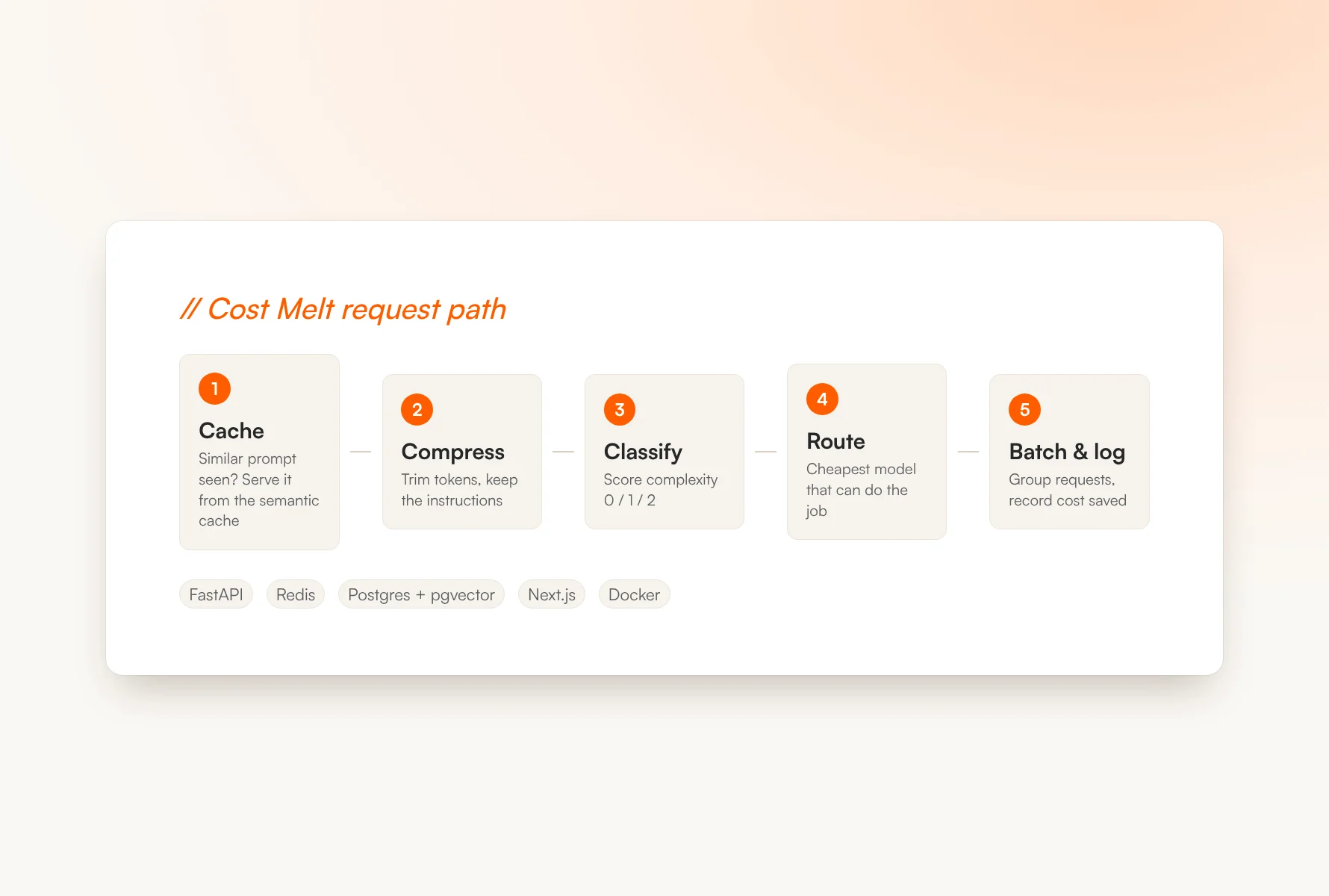
A proxy that sits between an application and its LLM providers. The app changes one URL, and every request goes through the same pipeline:
- Semantic cache. If a similar prompt was answered recently, return the cached answer at near-zero cost.
- Prompt compression. Rule-based trimming plus LLM summarization, keeping instructions intact.
- Complexity classification. An "overkill detector" scores the prompt 0, 1 or 2 from signals such as token count, code patterns and reasoning cues.
- Routing. Pick the cheapest model that can handle that complexity, across OpenAI, Anthropic, Groq and DeepSeek, taking provider health into account.
- Micro-batching and logging. Group compatible requests, then record tokens, cost and savings per request.
Every response comes back with metadata: which model was used, whether it was a cache hit, tokens in and out, and actual cost against a baseline.
Architecture
- Backend: FastAPI gateway orchestrating the routing engine, compressor, cache and batch queue
- Cache: embeddings stored in Supabase Postgres with pgvector for similarity search; Redis handles TTL and LRU eviction
- Batch queue: Redis-backed, flushed on a short window or when a batch fills
- Dashboard: Next.js analytics for savings over time, model mix, cache hit rate and complexity distribution
- Packaging: Docker Compose brings up the backend, dashboard, landing page and Redis together
Key decisions
A proxy, not an SDK
Integrating should be a one-line change. Putting the optimizations behind an HTTP endpoint means any language or framework can use them without new client code.
Cache before compressing
Checking the cache first means a hit skips every other step, including the compression call itself.
Tunable thresholds
The similarity threshold (0.92 by default), cache TTL, batch window and maximum batch size are all configuration, because the right trade-off between savings and answer quality depends on the workload.
What's next
- Benchmarks on real traffic to measure savings, rather than estimating them
- Training the complexity classifier on logged requests
- Per-user budgets and rate limits
// More projects
Have a look at my other work
Fraud Triage: deciding what to do with a fraud score
A LightGBM model plus a cost-based policy that decides approve, review or block under a fixed daily analyst budget. 66% lower total cost than reviewing the highest-probability cases.

Personal project
ML + full stack, solo
ReachScout: evidence-backed professional research
Finds the right recruiter, hiring manager or founder from public sources, shows the evidence behind every data point, and drafts a context-aware introduction. Built to be explicitly not a scraper or spam tool.

Personal project
Full stack, solo